12 Mar 2021

From my History of Architecture Notes - Chronology of Western Architecture

Here's what I found from my notes for the Chronology of Western Architecture. Beginning with the Prehistoric era - Ancient (Egypt, Greece, Rome) - Early Christian and Medieval - Romanesque - Gothic - Renaissance - American Colonial - Baroque - Rococo - Georgian - Neoclassical - Greek Revival - Victorian - Arts & Crafts Movement - Art Nouveau - Art Deco - Modern 'ISMS'.

Have a look at the picture below from my notes that highlights each period in the correct chronolocial order.


Page 01 Chronology of Western Architecture

Page 02 Chronology of Western Architecture

Hope you find the above information related with the chronology of Western Architecture useful.

Thank you for stopping by. Have a nice day.

11 Mar 2021

From my History of Architecture Notes - Roman Architecture

This post contains information on the influences of Roman Architecture viz. Social, Climatic, Geological, Religious etc. The Greek Architecture influenced the Etruscans and the Etruscans in turn influenced the Republican Roman Architecture. It further goes on to elaborate about the use of building materials by the Romans and the introduction of concrete.

It also contains notes on the characteristics of the Roman Public Buildings as the Forums, Temples, amphitheatres, Thermae, Tombs, etc. 


Roman Architecture
Page 01 Roman Architecture - Geological,
Climatic, Historical and Social Influences

Roman Architecture
Page 02 Roman Architecture -
Historical and Social Influences (contd.)

Roman Architecture
Page 03 Roman Architecture - Religion

Roman Architecture
Page 04 Architectural Characteristics of Etruscans

Roman Architecture
Page 05 Roman Architecture
Building Materials & Technology

Roman Architecture
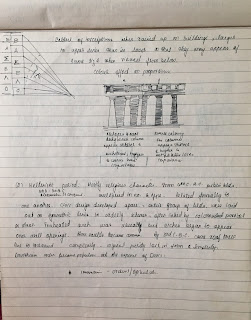
Page 06 Roman Architecture
Construction Technology

Roman Architecture
Page 07 Roman Architecture
Forum, Rectangular temples 

Roman Architecture
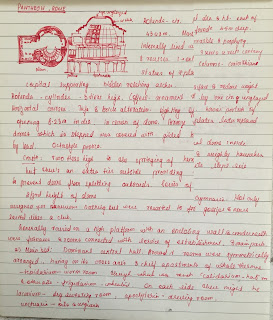
Page 08 Roman Architecture 
Pantheon, Thermae

Roman Architecture
Page 09 Roman Architecture 
Thermae (contd.)

Roman Architecture
Page 10 Roman Architecture Theatres

Roman Architecture
Page 11 Roman Architecture Theatres (contd.)

Roman Architecture
Page 12 Roman Architecture 
Triumphal Arches, Roman Houses, Tombs


I also found some notes later elaborating on Greek and Early Roman Architecture, which I plan to post next. Keep visiting this blog for more such information on History of Architecture.

Hope you find the notes useful.

Thank you for stopping by. Have a nice day!

7 Mar 2021

From my History of Architecture Notes - Greek Architecture


As mentioned in my earlier posts, these notes are references made from Sir Bannister Fletcher's History of Architecture. This post covers the period from Hellenic period to the Hellenistic period. 

Greek Architecture
Greek Architecture

The ancient Greeks, unlike their Minoan and Mycenaean ancestors, did not have the royalty and therefore had no need for palaces. Hence you will find their architecture dedicated to public buildings such as temples, central market place (agora) covered wit colonnade (stoa), monumental gateways (Propylon), the council building (bouleuterion), open air theatre, gymnasium(palaestra), and so on. Amongst these buildings it is the temples that captured the essence of Greek Architecture.
Effort was made to build temples in prominent positions using geometry and optical tricks such as thickening the lower parts of the columns, thickening the corner columns, etc. Such refinements indicate that the Greek temples were not just functional structures but also were symbolic and an important element in the civic landscape.

The notes consists of brief architectural characteristics of temples, geometry and optical tricks employed, sketches showing Greek Mouldings. Important buildings such as Propylaea Athens, the  Acropolis, temple of Parthenon, temple of Artemis, theatres, public buildings and domestic buildings are also mentioned.

Page 01 Hellenic Period

Page 02 Hellenistic Period

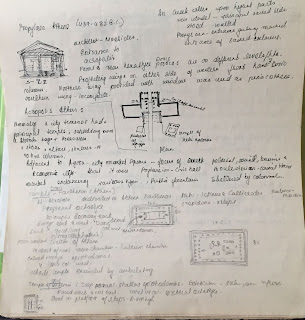
Page 03 Acropolis Athens, Temples
Page 03 Acropolis Athens, Temples of Parthenon, Artemis

Page 04 Temples
Page 04 Temples


Page 05 Greek Mouldings

Page 06 Public Buildings
Page 06 Theatre, Public Buildings

Page 07 Domestic Buildings


For more details on the Greek orders of Architecture (Doric, Ionic and Corinthian), please refer to the extra notes that will posted later.

Hope you find the above notes useful.

Thank you for stopping by. Have a nice day!

4 Mar 2021

From my History of Architecture Notes - Aegean Architecture


Everybody knows about Greek and the Romans and their influences on Art and Architecture. But before the dawn of Ancient Greece there was a vibrant Neolithic and then the Bronze age society that flourished in several different cultures found along the Aegean sea. It was established around 6000 BC, centered on several Cycladic Island off the southeast coast of Greece. They were home to farmers and seafaring traders and their inhabitants began to use local stone to create the famous Cycladic figures of musicians, fortified towns and burial mounds. Several of these islands had quarries of white marble that later began to be used in Ancient Greece buildings.

From around 3000 BC, another Bronze age culture thrived on much larger island of Crete which developed into Minoan Civilization. The Minoan people are name after their ruler – King Minos, who is described in Homer’s epic tales as ruling from his palace in the ancient city of Knossos. This palace dated from @1900 BC - 1100 BC was discovered by the archaeologist Heinrich Schliemann who located the site and then Arthur Evans who subsequently discovered and excavated the site. 

Here's what I found from my notes:

history notes aegean architecture
From my notes - Page 01

History Notes Aegean Architecture
From my notes - Page 02

History notes Aegean Architecture
From my notes - Page 03


Hope you can understand my handwriting. Some of it may be illegible as it was probably taken down hurriedly in the library in between two classes. Forgive me for that!

However, I hope it was an interesting read and you find the information useful in some way.

I plan to post more about the History of Greek and Roman Architecture in the coming days. Keep visiting this blog.

Thank you for stopping by. Have a great day ahead!


28 Feb 2021

From my History of Architecture Notes - Greek & Roman Gods

Recently, I was digging my book shelves for some old reference books when I found my notes from college days. It dates back from the year -1998 when I was pursuing my studies in Architecture. The notes includes timelines, sketches, brief writings on architectural styles from the past. I had made some of these notes during our live sessions with our professor who taught us History of Architecture, but most of them were made later when I would spend a few hours at our college library making notes from the book 'History of Architecture' by Sir Bannister Fletcher. 

I thought this was an interesting find, so I took the liberty to post some of these notes while I have some time in hand, hoping that it will help somebody out there who is searching for some information on History of Architecture. 

This post includes a brief on Greek and Roman Gods, for these revered figures were represented in the major architectural buildings in that era.  

I thought this was an interesting find and may help those of you who are looking for some information on Greek and Roman Figures and their influence on Architectural buildings.

Cover page of my History of Architecture Notes

The Greeks consecrated temples for these major Gods focusing on the exterior beauty rather than on the interiors. While the Romans followed and built temples for Gods too, they also began to build structures for their citizens including gathering areas like amphitheatres, bathhouses, etc. and utilitarian structures like bridges, aqueducts, roads, etc. 

Below is a snapshot from my notes on the Greek and Roman Gods. The twelve olympians include: Zeus, Hera, Apollo, Athena, Poseidon, Dionysos, Demeter, Artemis, Hermes, Aphrodite, Hephaestus, and Ares.

From my Notes - Greek and Roman Gods

For those of you who find my handwriting illegible, here's an updated list of the same.

List of Greek & Roman Gods

The list may not be comprehensive, and may have excluded some revered figures. If you find more you can add to the list. 

I hope to post more from my notes and I hope that this will be useful for those aspiring students of architecture and for anyone who wants to learn about history of architecture.

Thank you for stopping by...

Have a good day!


26 Feb 2021

Paint Mandalas for Healing


What are Mandalas?

People have got really creative during the past year of the pandemic and have used their time creatively. And I can say that as I have scrolled down pages of creative posts and various art portals day after day during the past one year. What I found commonly in all the posts were beautiful hand painted intricate mandalas posted not just by adults but by children too. This made me wonder why was it so popular and I decided to give it a try myself. I have drawn mandalas in the past too, but this time it was different-it was for a purpose!

I did a little study about the mandalas and here's a little brief about them. 

In Sanskrit, mandala meaning 'circle' is a geometric design that holds symbolic value in Hindu and Buddhist cultures. In their basic forms, mandalas are circles contained within a square and arranged into sections that are all organised around a single central point. 

In Hinduism, the belief is that by entering the mandala you are guided through the cosmic process of altering sufferings into joy and happiness. Similarly, in every culture, the mandalas serve the same purpose; centering of an individual or community to encourage introspection and ultimately that will make us aware of our place and purpose in the world which will lead to peace of mind.
Hand painted Mandalas


In Indian Architecture, you would have heard about Vastu Purusha Mandala; that is explained as a diagram of the universe. The Vastu Purusha Mandala has been the governing device for temple architecture. 

Carl Jung has popularized the mandala in the west. The Mandala, whatever form it takes, encourages individuals to explore ourselves, our relations, our purpose in this world. Nowadays, you will find Mandala coloring books for adults, recognized for their efficacy in reducing stress. You will find mandala paintings or posters in many offices. The purpose is universal: to encourage one to remain calm and recognize that all we need to do is focus on the centre to find peace.


Why and how I painted Mandalas?

I had some free time in hand and decided to make one mandala each day and see how it progresses. It was difficult to draw freehand in the beginning because I have lost the touch with pencil and paper, and I have been using the computer to aid me in my drawings and projects. But believe me, once I started I was not disappointed. 

Somebody has truly said "If you want peace of mind, stop fighting with your thoughts". 

It gave me a immense peace of mind as I tried to focus on the mandala and erase everything that was happening around me and with me. The few hours that I took off from the daily grind gave me immense joy and peace. It was kind of healing me from inside!

I started with drawing concentric circles on a sheet of paper, then I drew the rough design on the sheet with HB pencil and finally finished painting them sometimes with a single color or more. I used poster colors mostly, but my daughter also joined me once in a while and we explored with pencil colors, sketch pens and whatever other coloring medium we found lying around the house.


Step 01 - Draw concentric circles using a compass
Step 02 -  Sketch patterns using a HB pencil

Step 03: Paint or color them with the desired coloring medium

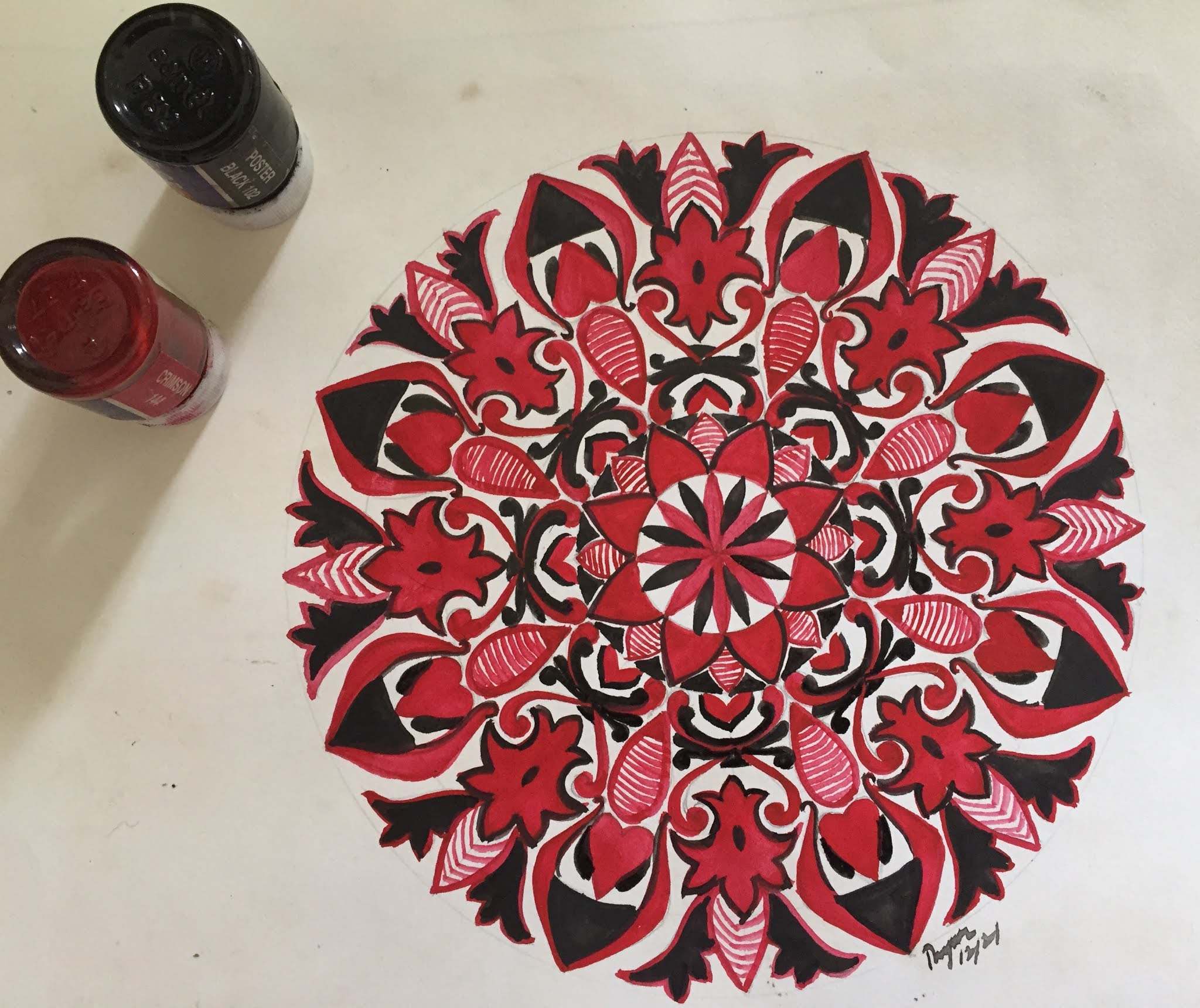
Mandala painted using Crimson Red and Black poster colors


I usually took a couple of days to paint the mandala; the first would be spent on making the rough sketch and the later would spent in coloring it. Here are some more mandalas as we explored them each day.

Mandala on black poster paper, made with pencil colors

Mandala on black chart paper, painted with poster colors


Mandala painted with light blue poster color

Mandala with poster colors

Mandala on white chart paper with poster colors

Mandala on white chart paper, painted with poster colors


Some useful tips to paint the mandala:

  • You require a lot of patience when you are dealing with geometric designs. Try to make the rough sketches with light H or HB pencil if you are going to color it later. That way, any time you can modify your pattern and it won't be messy.
  • Make use of geometric tools like compass, scales etc. to make them perfectly geometric and symmetrical. I tried a lot of freehand drawing - it was kind of challenging to make them perfectly geometric and repeat those patterns several times around the circle.

Painted mandalas for a poster at home

How to use these mandalas?

  • Make them on fabrics so you can use them to make cushion covers or wall hangings.
  • You can make them on sheet of your choice, get them framed and decorate your homes or offices.
  • Make small greeting cards to gift to your friends.
  • Paint your kitchen ware like dinner plates or tumblers and exhibit them when you host parties in your house. You can even make a gift set of hand-painted mandalas for your close friends who like hand-made stuff.
You can use the above tips or just paint them for fun or for your own peace of mind.

Hope you find this post useful.

Thanks for stopping by.

Have a nice day!

31 Jan 2021

Exploring Oil pastels with my daughter

While we deal with the pandemic which doesn't seem to be ending...here's a short post on using oil pastels.

Some Oil Pastel Techniques 


And while we experimented with different techniques here are some sample work done by my 12 year old. She may not have followed all the techniques but here they are as it is...


Hope you too involve yourself in lots of creativity during the pandemic and make use of your time more productively.


Thank you for stopping by...