Showing posts with label history of architecture. Show all posts

25 Apr 2021

From my History of Architecture Notes - Rise of European Cities

This post contains notes on the rise of European cities in the twelfth and thirteenth centuries. Keep reading to get complete information about the factors that influenced the rise of the European cities.

Rise of European Cities

Twelfth Century

Summary Chart

1100-1200 AD

  • Events and Developments
    • Strong centralized government under monarchs, notably in England and France.
    • Increase in population; large scale cultivation of new land.
    • Revolt by Byzantine ruled Bulgars (1185)
    • Growth of Russian culture, influenced by priests, teachers, artists and architects from Byzantium
    • By 1200 most cities Byzantine in character, law based on Byzantine
    • Economic and political decline of Byzantium; trade lost to Venice and Genoa; frequent military defeats and consequent reduction of territory.
  • People
    • Pierre Abelard, French theologian (1079-1142)
    • Fredrick Barbarossa, Holy Roman Emperor (1155-90)
    • Thomas Becket, Archbishop of Canterbury (1162-70)
  • Technology
    • Increasing use of windmill
    • Simple steering oar replaced by stem-post rudder
    • Manufacture of silk, Sicily
    • Paper making introduced
    • Woodcuts used for initial letters
    • First arrival of Chinese porcelain in Middle East
  • Religion
    • Success of cistercian order; abbeys built all over Europe
    • 2nd (1147) and 3rd (1182-92) Crusades directed against Muslims
    • Spread of Latin Christianity in Eastern Europe with decline of Byzantine Empire
  • Architecture
    • Church of St. Denis; Chatres Cathedral; Chateau Gillard, France
    • Cathedrals of Monreale and Cefalu; Sicily
    • Cathedral of St. George; Novgorod
    • Stone Churches, Suzdalia; Cathedral of the Dormition, Vladimir
  • Art and Music
    • Sculptures by Gislebertus, Autun Cathedral; France
    • Mosaics at Monreale, Sicily
    • Music in two to four parts developed at Notre Dame, Paris
    • Byzantine style wall paintings, Church of Nativity, Bethlehem
    • Virgin of Vladimir icon - a strong influence on Russian painting after its arrival in Kiev from Constantinople
  • Literature and learning
    • Toledo, Spain, centre for translation of ancient texts
    • Universities growing at Paris and Oxford; law schools at Pavia and Bologna
    • Birth of Russian literature marked by 'The Campaign of Igor' as epic prose poem
    • Chronicle of Kiev, Russian historical work
Rise of European Cities - 12th Century
Page 01
Rise of European Cities - 12th Century

Rise of European Cities - 12th Century
Page 02
Rise of European Cities - 12th Century

Rise of European Cities - 12th Century
Page 03
Rise of European Cities - 12th Century

Rise of European Cities - 12th Century
Page 04
Rise of European Cities - 12th Century


Thirteenth Century

Map - European cities in the 13th Century


Summary Chart

1200-1300 AD

Western Europe

  • Events and Developments
    • France most powerful, advanced state
    • John of England's Magna Carta (1215)
    • Decline of Holy Roman Empire; concession of power in Germany to princes
    • Christian reconquest of Spain complete
    • Commercial dominance of north Italian city states
    • Formation of Hanseatic League, commercial and political alliance of Germanic towns
    • Erosion of Feudalism
  • People
    • Fredrick II, Holy Roman Emperor 1215-50
    • Louis IX, French King 1226-70
    • St. Thomas Aquinas, medieval philosopher
    • Roger Bacon, English Scientist
    • Marco Polo, Italian traveller
  • Technology
    • Introduction of cog (type of cargo vessel)
    • Invention of wheel barrow
    • Spectacles, spinning wheel in common use
    • Minting of gold coins in Italy
  • Religion
    • Authority of Popes confirmed by 4th Lateran council (1215)
    • Declaration of Albigensian Crusade by Pope Innocent III
    • Flowering of Catholic Scholastic theology under Albertus Magnus and Thomas Aquinas
    • Last phase of Crusades in Holy Land
  • Architecture
    • Rheims, Amiens Cathedrals, Churches of Notre Dame and Saint Chapelle, Paris
    • Florence, Siena Cathedrals, CAstel del Monte
    • Welsh Castles
    • Cologne Castles
  • Art and Music
    • Nicola Pisano's pulpits at Pisa and Sienna
    • Sculptures at Chartres, Rheims, Strasbourg
    • Literature and Learning
    • Universities founded at CAmbridge and Padua
    • Liber Abaci, account in Latin of arabic numerals

Eastern Europe

  • Events and Developments
    • Mongol conquest of Russia, Poland and Hungary
    • Sack of Kiev (1240)
    • Gradual rise of Moscow
  • People
    • Wencestas I, King of Bohemia (1230-53)
    • Alexander Nevski, Prince of Novgorod (1236-63)
    • Batu Khan, Mongol ruler of Eastern Europe
  • Religion
    • Suppression of orthodoxy in Russia by Mongols
    • Architecture
    • Suzdal Cathedral; Church of St. George, Yuriev-Polsky. Pjatnica Church, Chernigov, Russia
  • Art and Music
    • Relief Sculptures at Suzdal Cathedral and St. George, Yuriev-Polsky
Rise of European Cities - 13th Century
Page 01
Rise of European Cities - 13th Century

Rise of European Cities - 13th Century
Page 02
Rise of European Cities - 13th Century

Rise of European Cities - 13th Century
Page 03
Rise of European Cities - 13th Century

Rise of European Cities - 13th Century
Page 04
Rise of European Cities - 13th Century


Hope you find these notes useful.

Thankyou for stopping by. Have a nice day!

8 Apr 2021

From my History of Architecture Notes - Mannerist Architecture

Mannerist Architecture can be categorized as art and architecture style that developed between the High Renaissance and Baroque periods (1520 – 1600). It represents an ideal beauty rather than natural images, using characteristic distortion and exaggeration of human proportions, perspective, etc.

Mannerist Architecture


Page 01 - Mannerist Architecture


Page 02 - Mannerist Architecture


Hope you find the notes useful.

Thank you for stopping by. Have a good day.


1 Apr 2021

From my History of Architecture Notes - Gothic Architecture

This post has notes covering the Gothic Architecture in France, Italy, Spain, Evolution of Gothic Vaulting in British Isles and Central Europe. It briefly outlines the architectural character of the cathedrals and churches that existed in that era. It highlights how Gothic Architecture is amalgamation of the Greek inspiration, Roman Construction and Byzantine decoration. Gothic Architecture is mainly characterized by Stained glass windows, Pointed arches, Experiments with flying and pier buttresses.

Gothic Architecture -  France, Italy, Spain
Page 01 Gothic Architecture -
 France, Italy, Spain

Gothic Architecture -  British Isles
Page 02 Gothic Architecture -
 British Isles

Gothic Architecture -  Central Europe
Page 03 Gothic Architecture -
 Central Europe

Some extra notes for Gothic Architecture

Here's another page of notes I found elsewhere and I thought I should club it here with the above notes. 
The Gothic style of architecture that existed from 1200 to 1400 AD can be divided into three distinct categories: Early, High and Late. This picture below from my notes highlights the architectural style that developed during each of the above categories.
Gothic Style - Early, High, Late
Gothic Architecture Style


Hope you find the notes useful.

Thank you for stopping by!

7 Mar 2021

From my History of Architecture Notes - Greek Architecture


As mentioned in my earlier posts, these notes are references made from Sir Bannister Fletcher's History of Architecture. This post covers the period from Hellenic period to the Hellenistic period. 

Greek Architecture
Greek Architecture

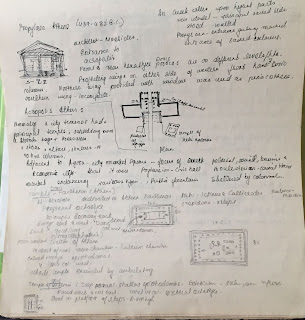
The ancient Greeks, unlike their Minoan and Mycenaean ancestors, did not have the royalty and therefore had no need for palaces. Hence you will find their architecture dedicated to public buildings such as temples, central market place (agora) covered wit colonnade (stoa), monumental gateways (Propylon), the council building (bouleuterion), open air theatre, gymnasium(palaestra), and so on. Amongst these buildings it is the temples that captured the essence of Greek Architecture.
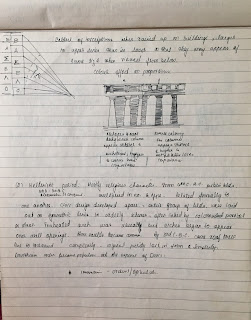
Effort was made to build temples in prominent positions using geometry and optical tricks such as thickening the lower parts of the columns, thickening the corner columns, etc. Such refinements indicate that the Greek temples were not just functional structures but also were symbolic and an important element in the civic landscape.

The notes consists of brief architectural characteristics of temples, geometry and optical tricks employed, sketches showing Greek Mouldings. Important buildings such as Propylaea Athens, the  Acropolis, temple of Parthenon, temple of Artemis, theatres, public buildings and domestic buildings are also mentioned.

Page 01 Hellenic Period

Page 02 Hellenistic Period

Page 03 Acropolis Athens, Temples
Page 03 Acropolis Athens, Temples of Parthenon, Artemis

Page 04 Temples
Page 04 Temples


Page 05 Greek Mouldings

Page 06 Public Buildings
Page 06 Theatre, Public Buildings

Page 07 Domestic Buildings


For more details on the Greek orders of Architecture (Doric, Ionic and Corinthian), please refer to the extra notes that will posted later.

Hope you find the above notes useful.

Thank you for stopping by. Have a nice day!

4 Mar 2021

From my History of Architecture Notes - Aegean Architecture


Everybody knows about Greek and the Romans and their influences on Art and Architecture. But before the dawn of Ancient Greece there was a vibrant Neolithic and then the Bronze age society that flourished in several different cultures found along the Aegean sea. It was established around 6000 BC, centered on several Cycladic Island off the southeast coast of Greece. They were home to farmers and seafaring traders and their inhabitants began to use local stone to create the famous Cycladic figures of musicians, fortified towns and burial mounds. Several of these islands had quarries of white marble that later began to be used in Ancient Greece buildings.

From around 3000 BC, another Bronze age culture thrived on much larger island of Crete which developed into Minoan Civilization. The Minoan people are name after their ruler – King Minos, who is described in Homer’s epic tales as ruling from his palace in the ancient city of Knossos. This palace dated from @1900 BC - 1100 BC was discovered by the archaeologist Heinrich Schliemann who located the site and then Arthur Evans who subsequently discovered and excavated the site. 

Here's what I found from my notes:

history notes aegean architecture
From my notes - Page 01

History Notes Aegean Architecture
From my notes - Page 02

History notes Aegean Architecture
From my notes - Page 03


Hope you can understand my handwriting. Some of it may be illegible as it was probably taken down hurriedly in the library in between two classes. Forgive me for that!

However, I hope it was an interesting read and you find the information useful in some way.

I plan to post more about the History of Greek and Roman Architecture in the coming days. Keep visiting this blog.

Thank you for stopping by. Have a great day ahead!


28 Feb 2021

From my History of Architecture Notes - Greek & Roman Gods

Recently, I was digging my book shelves for some old reference books when I found my notes from college days. It dates back from the year -1998 when I was pursuing my studies in Architecture. The notes includes timelines, sketches, brief writings on architectural styles from the past. I had made some of these notes during our live sessions with our professor who taught us History of Architecture, but most of them were made later when I would spend a few hours at our college library making notes from the book 'History of Architecture' by Sir Bannister Fletcher. 

I thought this was an interesting find, so I took the liberty to post some of these notes while I have some time in hand, hoping that it will help somebody out there who is searching for some information on History of Architecture. 

This post includes a brief on Greek and Roman Gods, for these revered figures were represented in the major architectural buildings in that era.  

I thought this was an interesting find and may help those of you who are looking for some information on Greek and Roman Figures and their influence on Architectural buildings.

Cover page of my History of Architecture Notes

The Greeks consecrated temples for these major Gods focusing on the exterior beauty rather than on the interiors. While the Romans followed and built temples for Gods too, they also began to build structures for their citizens including gathering areas like amphitheatres, bathhouses, etc. and utilitarian structures like bridges, aqueducts, roads, etc. 

Below is a snapshot from my notes on the Greek and Roman Gods. The twelve olympians include: Zeus, Hera, Apollo, Athena, Poseidon, Dionysos, Demeter, Artemis, Hermes, Aphrodite, Hephaestus, and Ares.

From my Notes - Greek and Roman Gods

For those of you who find my handwriting illegible, here's an updated list of the same.

List of Greek & Roman Gods

The list may not be comprehensive, and may have excluded some revered figures. If you find more you can add to the list. 

I hope to post more from my notes and I hope that this will be useful for those aspiring students of architecture and for anyone who wants to learn about history of architecture.

Thank you for stopping by...

Have a good day!