Showing posts with label history. Show all posts

22 Apr 2021

From my History of Architecture Notes - Indo Islamic Architecture

This section of the my notes from History of Architecture throws light on development of Indo Islamic Architecture also known as the Sarcenic style covering the time period that was ruled by the 1) Slave dynasty 2) Khiljis 3) Tughluqs 4) Sayyids 5) Lodis and 6) the Mughals.

Indo Islamic Architecture - Introduction
Page 01 Indo Islamic Architecture -
Introduction

Indo Islamic Architecture - Slave Dynasty, Khiljis, Tughlaqs
Page 02 Indo Islamic Architecture -
Slave Dynasty, Khiljis, Tughlaqs

Indo Islamic Architecture - Regional Variation
Page 03 Indo Islamic Architecture -
Regional Variation

Indo Islamic Architecture - Regional Variation (contd.)
Page 04 Indo Islamic Architecture -
Regional Variation (contd.)

Indo Islamic Architecture - Regional Variation (contd.)
Page 05 Indo Islamic Architecture -
Regional Variation (contd.)

Indo Islamic Architecture - Mughal Empire
Page 06 Indo Islamic Architecture -
Mughal Empire

The next and probably the last post that will follow Indo-Islamic Architecture, will highlight the development of Islamic Architecture in India. So keep looking out for more information and let me know if they helped you even in some small way. 

Thank you for stopping by!

25 Mar 2021

From my History of Architecture Notes - Byzantine Architecture

Byzantine Architecture originated chiefly in Constantinople, the ancient Greek town of Byzantium. Byzantine Architecture rose in response to needs of the Eastern, or Orthodox Church. They preferred a more contemplative form of popular worship focused on the veneration of icons. These were portraits of sacred personages - frontal view in a highly conceptual and stylized manner. Pictorial representation in form of wall painting or mosaics served as icon, it generally took the form of a small painted panel. The style developed through three distinct periods; Early, Middle (Macedonian Renaissance) and Comnenian period.

This post contains in brief the architectural order that evolved during the Byzantine Architectural Period. It has notes on the development of the churches, their plans, the decorative character, use of mosaics as materials, the construction technology and so on.

Byzantine Architecture
Page 01 Byzantine Architecture

Byzantine Architecture
Page 02 Byzantine Architecture (contd.)

Below is an additional note on Byzantine Architecture that I found from my files. Have added it for further reference.

Byzantine Architecture
Byzantine Architecture 

Hope you find the notes useful.

Thank you for stopping by.

28 Feb 2021

From my History of Architecture Notes - Greek & Roman Gods

Recently, I was digging my book shelves for some old reference books when I found my notes from college days. It dates back from the year -1998 when I was pursuing my studies in Architecture. The notes includes timelines, sketches, brief writings on architectural styles from the past. I had made some of these notes during our live sessions with our professor who taught us History of Architecture, but most of them were made later when I would spend a few hours at our college library making notes from the book 'History of Architecture' by Sir Bannister Fletcher. 

I thought this was an interesting find, so I took the liberty to post some of these notes while I have some time in hand, hoping that it will help somebody out there who is searching for some information on History of Architecture. 

This post includes a brief on Greek and Roman Gods, for these revered figures were represented in the major architectural buildings in that era.  

I thought this was an interesting find and may help those of you who are looking for some information on Greek and Roman Figures and their influence on Architectural buildings.

Cover page of my History of Architecture Notes

The Greeks consecrated temples for these major Gods focusing on the exterior beauty rather than on the interiors. While the Romans followed and built temples for Gods too, they also began to build structures for their citizens including gathering areas like amphitheatres, bathhouses, etc. and utilitarian structures like bridges, aqueducts, roads, etc. 

Below is a snapshot from my notes on the Greek and Roman Gods. The twelve olympians include: Zeus, Hera, Apollo, Athena, Poseidon, Dionysos, Demeter, Artemis, Hermes, Aphrodite, Hephaestus, and Ares.
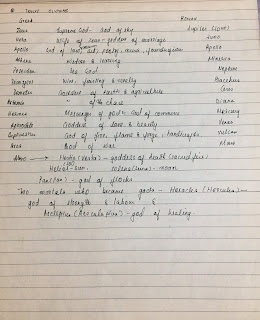
From my Notes - Greek and Roman Gods

For those of you who find my handwriting illegible, here's an updated list of the same.

List of Greek & Roman Gods

The list may not be comprehensive, and may have excluded some revered figures. If you find more you can add to the list. 

I hope to post more from my notes and I hope that this will be useful for those aspiring students of architecture and for anyone who wants to learn about history of architecture.

Thank you for stopping by...

Have a good day!