Showing posts with label sonobe cube. Show all posts

7 Feb 2018

Origami Tutorial: Sonobe unit and a glimpse into Sonobe Variations


The last few months have been a great journey while we explored the world of 3D and modular origami. In the process, we discovered beautiful models designed by several origami artists around the world. Most popular is, of course, the Sonobe model. On digging out the internet we found that their origin is still unknown. Two of the possible creators could be Toshie Takohama and Mitsunobu Sonobe, who have published several books together and are members of the Origami Group. 

The beauty of the Sonobe unit lies in its flexibility to combine in several different combinations that can be used to build a simple triangular bipyramid, cube, trisoctahedron to many complicated polyhedrons. Origami artists around the world have experimented with this basic unit and have built several variations using the same unit. 

Here's a picture tutorial you can follow to make a Sonobe unit.
Art Hours
Sonobe Unit: Picture Tutorial by Art Hours

The model made of three units results in a triangular bipyramid. Using six units results in a cube. Using twelve Sonobe units, results in a triakis octahedron.  Using 30 units you can make a triakis icosahedron. 

Here's a picture of a bipyramid (also called a dipyramid) that was built using 3 Sonobe units. Only 3 units were used to build the bipyramid which has 6 triangular faces and hence can also be called a hexahedron.
tutorial by art hours
A Triangular Bipyramid using 3 sonobe units

Below is a picture of a cube that was built using 6 nos. of Sonobe units. This one has six square faces as visible in the picture.
tutorial by art hours
Origami Cube using 6 Sonobe units

We found several models of the Sonobe on the internet and had fun building models from different types of variations. Below is a picture of a Trisoctahedron we built using 12 units of the Sonobe unit but its a slightly different variation of the Sonobe unit. The shape that resulted is actually an octahedron with triangular pyramids added on its every face. So, it has 8 extreme ends or tips and each tip has 3 triangular faces. Totally, it has 24 triangular faces.

We used magazine paper to build the model...one way of putting magazine paper to good use instead of throwing them away, and after all, recycling is the buzzword nowadays!

Trisoctahedron made from 12 units - variation of Sonobe unit

Here are two more models using the same variation of Sonobe unit used above for the trisoctahedron. The cube was made using 6 units and the Triambic Icosahedron was made using 30 units.

Left Front: Cube using 6 units
Right Back: Triambic Icosahedron using 30 units

We tried out several other variations too. Below is something splendid we tried using other variations developed by Maria Sinayskaya. She calls it the Rose Kusudama. You will find the model diagrams on her website. By the way kusudama is a Japanese word which means medicine balls (kusuri means medicine and tama means a ball in Japanese). They were used for incense and potpourri; nowadays typically used as decorations or gifts.

The first model you see in the picture below is a yellow rose kusudama, made from 12 nos. of 1:2 rectangular sheets. The second model is a pink rose kusudama, made from 12 nos. square sheets. Personally, I loved the second model, as it turns out to be a sturdy one. 

Rose Kusudama using 12 nos. 1:2 Rectangular sheet

Rose Kusudama using 12 nos. Square sheet

We are still exploring many other origami models and designing our own variations too.

Our journey is Origami is getting interesting day by day...keep visiting us more often to learn and explore the art world. 

Stay with us, learn, like and share. Your valuable comments and feedback are welcome.

Follow us on Instagram to explore what we are working on currently: www.instagram.com/archguide16 or stop by our FB page:fb.me/arthours to explore our tutorials and student workshops.

Thank you for stopping by.

Have a good day...
---

19 May 2016

What is Modular Origami: A Teeny-Weeny Glimpse to the World of Modular Origami

We have often seen or heard the word Modular Origami. Do you know what it really is?

Let's have a brief glimpse on Modular Origami today.

nupur acharjya
Modular Origami with Polyhedrons
When you google on the internet on modular origami, you will find various versions and answers. So here we go....

What is Modular Origami?
Modular Origami or Unit Origami is a paper folding technique which uses two or more sheets of paper to create a larger and a more complex structure that would not be possible using single-piece origami techniques. Each individual sheet of paper is folded into a module or a unit, and then these modules are assembled into a flat shape or 3D structure by inserting the flaps into pockets created by the folding process. Assembling them requires no glue or thread.

What holds the model together?
The insertions create tension or friction that holds the model together.

Historical Evidence:
If you want to know the history then there's a lot of information on the net on that too. However, the first historical evidence for a modular origami design comes from a  Japanese book by Hayato Ohoka published in 1734 called Ranma Zushiki.

Some of the most Popular Modular Origami designers include:
Misonobu Sonobe, Tomoko Fuse, Kunihiko Kasahara, Miyuki  Kawamura, David Mitchell, Heinz Strobl and yes, I was immensely pleased to find an Indian name on the list: Meenakshi Mukherjee.

There are several traditional Japanese modular origami designs. The modular origami forms may be flat or 3-D. The flat forms are usually polygonal forms, stars, rotors or rings while the 3-D forms tend to be regular polyhedra or tessellations of simple polyhedra. They have been named after the person who designed and first folded them.

Modular origami techniques have been used to create boxes with lids, containers etc. Tomoko Fuse is a name synonymous with modular origami boxes. If you happen to find then there's a book called 'Fabulous Origami Boxes' by Tomoko Fuse. 

To keep it simple and short, Modular Origami is a two staged paper folding technique, which uses multiple sheets of paper. The first stage is to fold individual sheets of paper into identical modules or units. In the second stage, the modules are assembled into an integrated flat shape or a 3-D structure.

Some people love modular origami while some do not like the idea of folding the same units a number of times. It all boils down to the fact that you need to have a fair amount of patience and love for the art of folding.

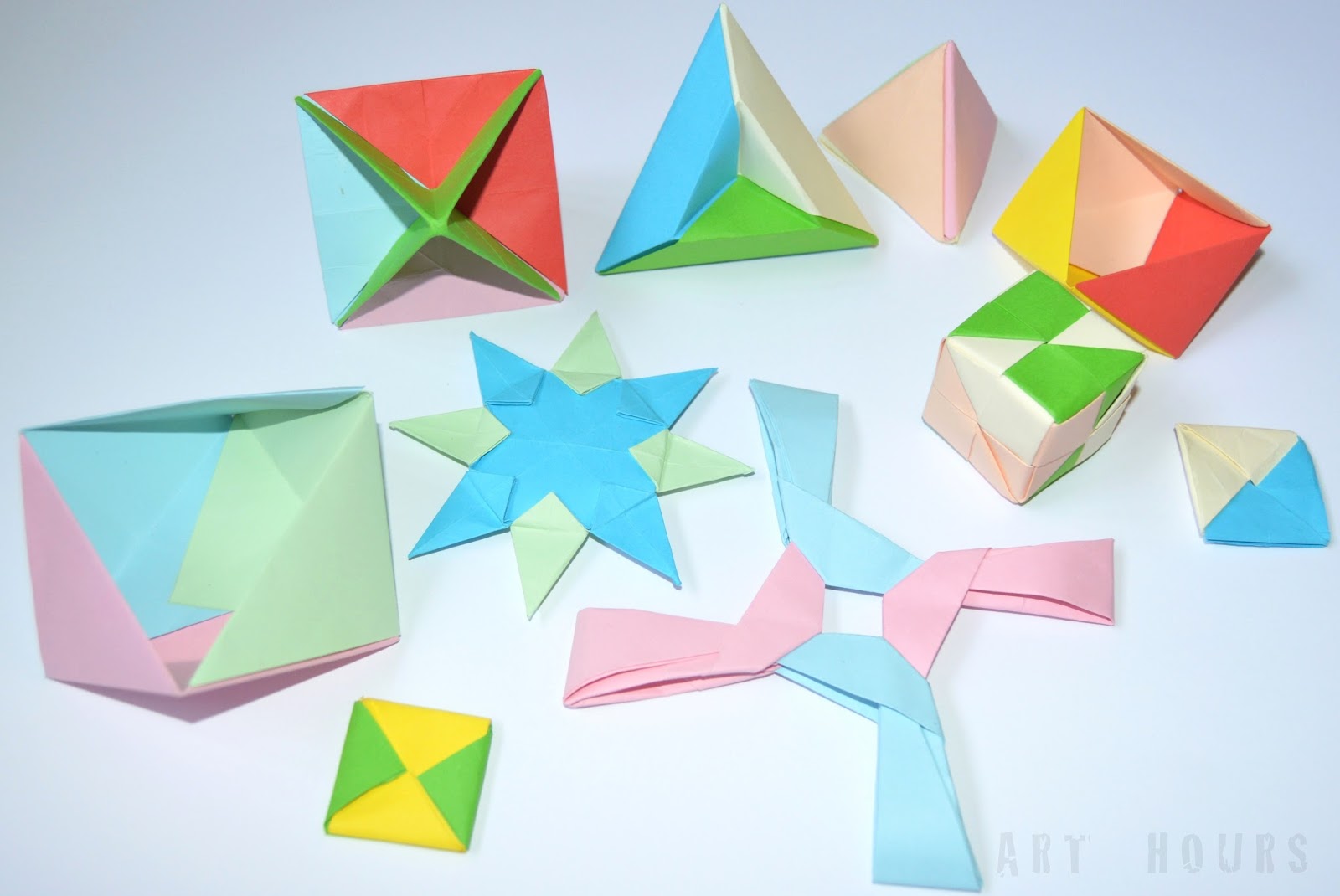
Here is a teeny-weeny glimpse of some modular flat origami forms designed by different people from around the world and folded by me, to understand and explain the concept of Modular Origami better to all of you out there.

nupur acharjya archguideforyou.blogspot.com
The 8-pointed Modular Origami Star
The above beautiful 8-point modular origami star is fairly simple to fold and requires minimal patience. I am not sure as to who originally designed it but discovered this star's diagram that was made by Fumiaki Shingu.

archguideforyou.blogspot
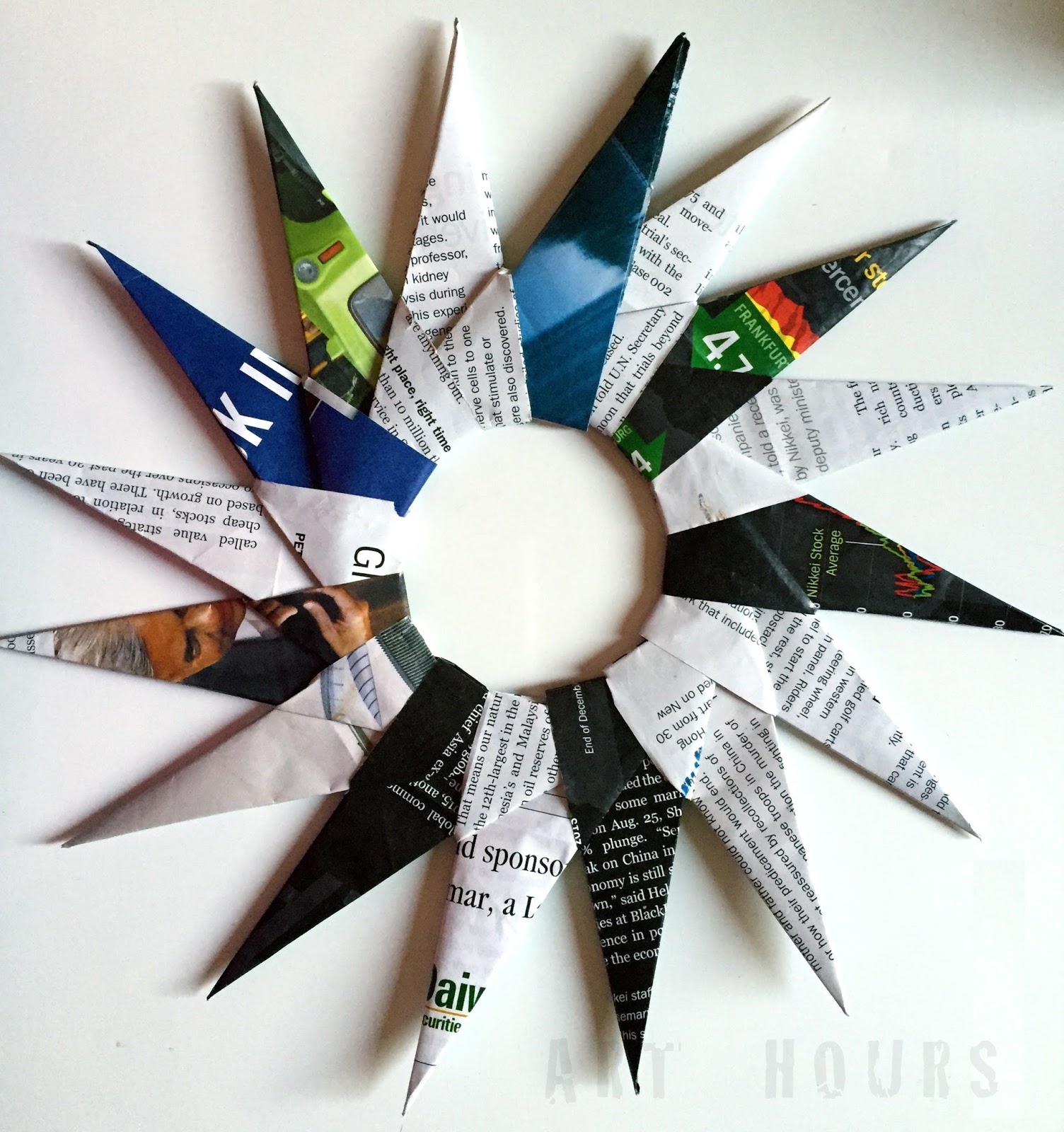
16-point Modular Origami Star 
This requires 16 units to be assembled together. It is easy to assemble the modular units but requires a lot of patience since you have to keep folding 16 similar units. 

nupur acharjya
Traditional Ninja Star
nupur acharjya
The Rotor/Frisbee - Designed by Francisco Caboblanco
Modular Origami can be fun for the kids as they enjoy folding these small toys like the traditional ninja star and the frisbee/rotor as shown in the pictures above.

nupur acharjya
8-point Star - Designed by Tomoko Fuse
This 8-pointed star known as 8-point Fuse star is named after the renowned Japanese Origami artist  -Tomoko Fuse. Such stars make beautiful pieces for decoration during parties or ceremonies.

Now let's have a look at the 3-D structures/polyhedrons possible using Modular Origami. Again, these have been designed by different people and accordingly named after the designer.

nupur acharjya
From L to R : Tricorne, Triangular pyramid, Triangular Boxes
The above tetrahedrons are easy to assemble. The Tricorne as designed by David Mitchell, shown in the picture in the extreme left corner, is a tetrahedron with 12 faces and is assembled using only 3 modular units. Similarly, the triangular pyramid with 4 equilateral triangle faces (next to the tricorne in the picture above), is made from 4 units only. While the two triangular boxes that you see are made using only 3 modular units each and is designed by Francisco Caboblanco.

nupur acharjya
From L to R: The Sonobe Cube and
The Japanese Menko
In the above picture you see a 3D cube designed by Sonobe Mitsonobu, hence the name. It uses 6 modular units interwoven into each other. The small flat 2D shape lying next to the Sonobe Cube is the traditional Japanese Menko, a traditional origami envelope. It was real fun folding this one and you need to interlock only 2 units into each other.

nupur acharjya
The Jackson Cube
The above simple cube is really very easy to fold and named Jackson cube after the person who designed it of course. It is much simple and easier to fold this one as compared to the Sonobe cube. A must try for all kids or beginners who want to start origami.

The above examples I have cited are just some small examples of Modular Origami. There are a plethora of possibilities with Modular Origami. I hope this article helps you initiate and explore the world of Modular Origami.
---